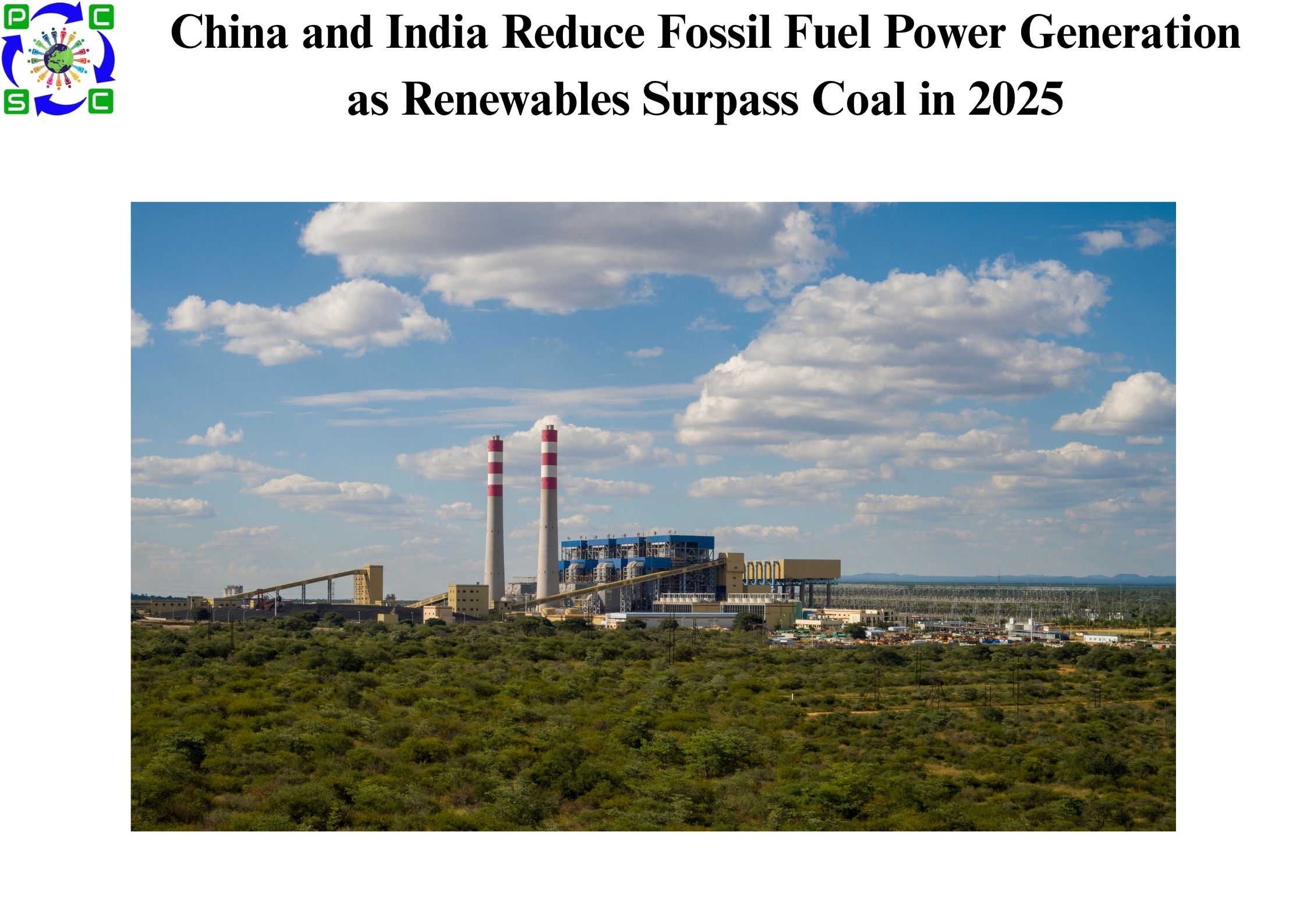
China and India jointly reduced fossil fuel-based electricity generation by 108 TWh, even as rapid growth in solar and wind power accelerated across Asia.
In 2025, renewables accounted for 33.8% of global electricity generation, surpassing coal at 33.0%. Solar and wind together met 99% of the increase in global electricity demand, while coal generation declined by 63 TWh.
Beijing and New Delhi played a pivotal role in reshaping global energy dynamics in 2025, reducing reliance on fossil fuels despite rising electricity demand. This reflects a broader structural shift across Asia, where renewables are increasingly meeting incremental demand.
In China, fossil fuel-based generation declined by 0.9% (56 TWh), while solar power surged by 40%, adding 336 TWh. Solar alone contributed nearly two-thirds of the country’s additional electricity demand, significantly transforming growth patterns in the world’s largest power market.
India followed a similar path, with fossil generation falling by 3.3% (52 TWh) while renewable output rose by 24%, adding 98 TWh. This underscores how emerging economies are beginning to decouple economic growth from fossil fuel dependence.
Despite this transition, fossil fuels still dominate the energy mix, accounting for 58% of electricity generation in China and 73% in India. However, renewables are now capturing the majority of new demand growth.
Globally, coal generation fell by 63 TWh, marking its first annual decline since 2020, while solar and wind dominated electricity demand growth by supplying 99% of the increase. This indicates that new capacity additions are overwhelmingly clean.
The trend is especially evident in fast-growing economies, where renewable deployment is increasingly replacing coal and gas expansion, reshaping global energy supply patterns and influencing both economic and geopolitical dynamics.
In OECD countries, the transition is even more advanced. Fossil fuel generation has declined by 19% since its 2007 peak, and in 2025, fossil sources made up 48% of electricity generation—below the global average of 57%. Wind and solar have expanded by 2,138 TWh over the same period, fully offsetting fossil declines while meeting new demand. Power sector emissions in OECD economies have also dropped by 28% since 2007, reflecting a long-term structural shift driven by policy support, market forces, and falling technology costs.
Economically, renewables remain strongly competitive. In 2025, the levelised cost of electricity averaged $39/MWh for solar and $40/MWh for onshore wind, compared to $102/MWh for combined cycle gas turbines. This cost advantage continues to drive investment decisions across both developed and emerging markets.
For energy leaders and investors, 2025 marks a structural inflection point. Electricity demand continues to rise, but renewables are now the primary source of new supply. This shift is reshaping procurement strategies, capital allocation, and long-term energy planning.
Governments, meanwhile, face the dual challenge of scaling renewable infrastructure while ensuring grid stability through storage, transmission, and flexibility investments.
While fossil fuels still play a significant role—particularly in China and India—the growth engine of the global power system has clearly shifted toward renewables, with far-reaching implications for emissions, energy security, and global investment flows.