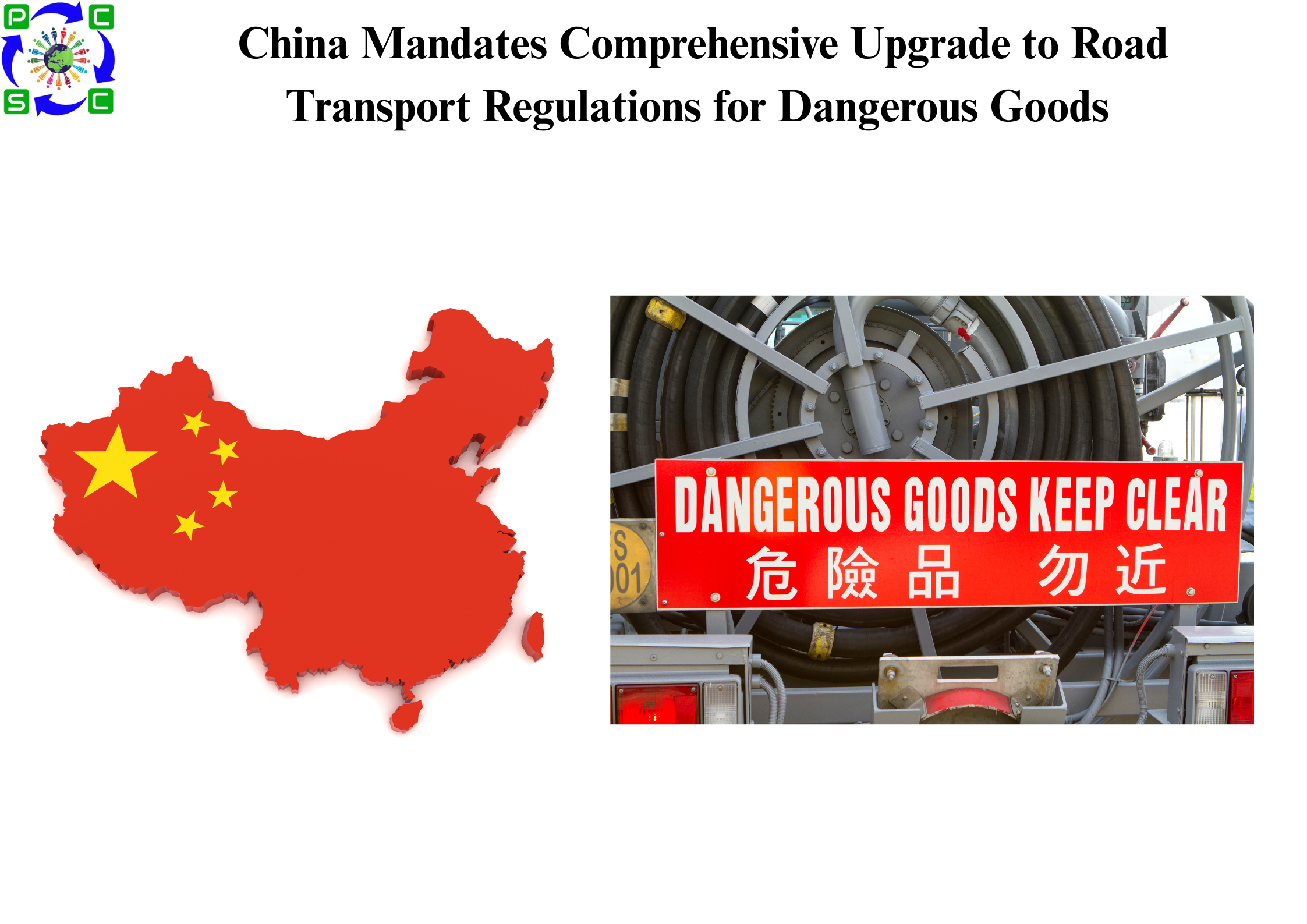
On December 31, 2025, the National Technical Committee on Road Transport Standardization announced that, in line with the national plan for the formulation and revision of standards, it has organized the development of seven mandatory national standards under the Regulations Concerning Road Transportation of Dangerous Goods series. These regulations are a vital part of China’s road transport standard system for dangerous goods and form the core technical requirements governing their transportation.
From Recommended to Mandatory: Elevating the Status of the Standard
In 2018, the Ministry of Transport organized the revision and issuance of the industry standard Regulations Concerning Road Transportation of Dangerous Goods (JT/T 617—2018). As a supporting technical specification for the Administrative Measures for the Safety of Road Transport of Dangerous Goods and the Regulations on the Administration of Road Transport of Dangerous Goods, this standard set out detailed technical requirements covering various elements and stages of road transport for dangerous goods.
However, because JT/T 617 is an industry-recommended standard, the enforceability of certain technical provisions has been limited in practice. To strengthen the authoritative role of standards in safety management, improve their technical guidance across the entire supply chain, and enable comprehensive supervision of all entities, elements, and processes involved in the transport of dangerous goods, it has become necessary to elevate this recommended industry standard to a mandatory national standard.
The upgraded standard is intended to systematically regulate key aspects of dangerous goods road transport, including classification, transport packaging, consignment, loading and unloading, and transport operations. It is planned as a seven-part series, comprising the following:
Part 1: General Provisions (Plan No. 20241015-Q-348)
This part sets out basic transport conditions, exemptions, requirements for multimodal transport, personnel safety training, and safety requirements for participants and high-risk dangerous goods. It applies to all road transport of dangerous goods and clarifies the fundamental conditions, exemption criteria, international multimodal transport linkages, and participant safety obligations.
Part 2: Classification (Plan No. 20241017-Q-348)
This part specifies the principles and requirements for classifying dangerous goods transported by road, including both general and specific classification rules. It applies to determining hazard classes, hazard types (groups), and packing groups.
Part 3: Index of Dangerous Goods Names and Transport Requirements (Plan No. 20241016-Q-348)
This part defines naming requirements for dangerous goods, the structure and content of the dangerous goods list for road transport, and transport requirements for goods in limited and excepted quantities.
Part 4: Provisions for the Use of Transport Packagings (Plan No. 20241018-Q-348)
This part specifies requirements for the selection and use of various transport packagings, including small packagings, intermediate bulk containers (IBCs), large packagings, portable tanks, road tank containers, swap tank bodies, multiple-element gas containers (MEGCs), tank shells of tank vehicles, and solid bulk containers.
Part 5: Consignment (Plan No. 20241013-Q-348)
This part establishes general consignment requirements for dangerous goods transported by road, including package marking and labeling, marking and labeling of overpacks and mixed packagings, placarding, and transport documentation. It focuses on requirements to be met prior to vehicle departure.
Part 6: Provisions on Conditions for Carriage, Loading, Unloading, and Handling (Plan No. 20241014-Q-348)
This part outlines basic requirements for loading and unloading conditions and operations, covering packaged goods, solid bulk goods, and tank transport, as well as operational procedures and special requirements for temperature-controlled dangerous goods. It applies to the selection of transport units and loading/unloading operations.
Part 7: Transport Conditions and Operational Requirements (Plan No. 20241011-Q-348)
This part specifies requirements related to transport equipment, personnel qualifications, transport operations, and emergency response for the road transport of dangerous goods.
In developing this series, reference was made to the Agreement Concerning the International Carriage of Dangerous Goods by Road (ADR) (2025 edition), while fully considering China’s regulatory practices and industry development needs. The objective is to provide robust, compliant technical support for dangerous goods road transport, advance the scientific and standardized management of transport operations, and effectively safeguard transport safety.
Purpose of Formulation
The purpose of this standard series is to strengthen safety governance in the road transport of dangerous goods, enhance the mandatory standards framework, improve the overall regulatory system, promote international road transport cooperation, support broader opening-up, and provide solid technical assurance for the safe and efficient transport of dangerous goods.