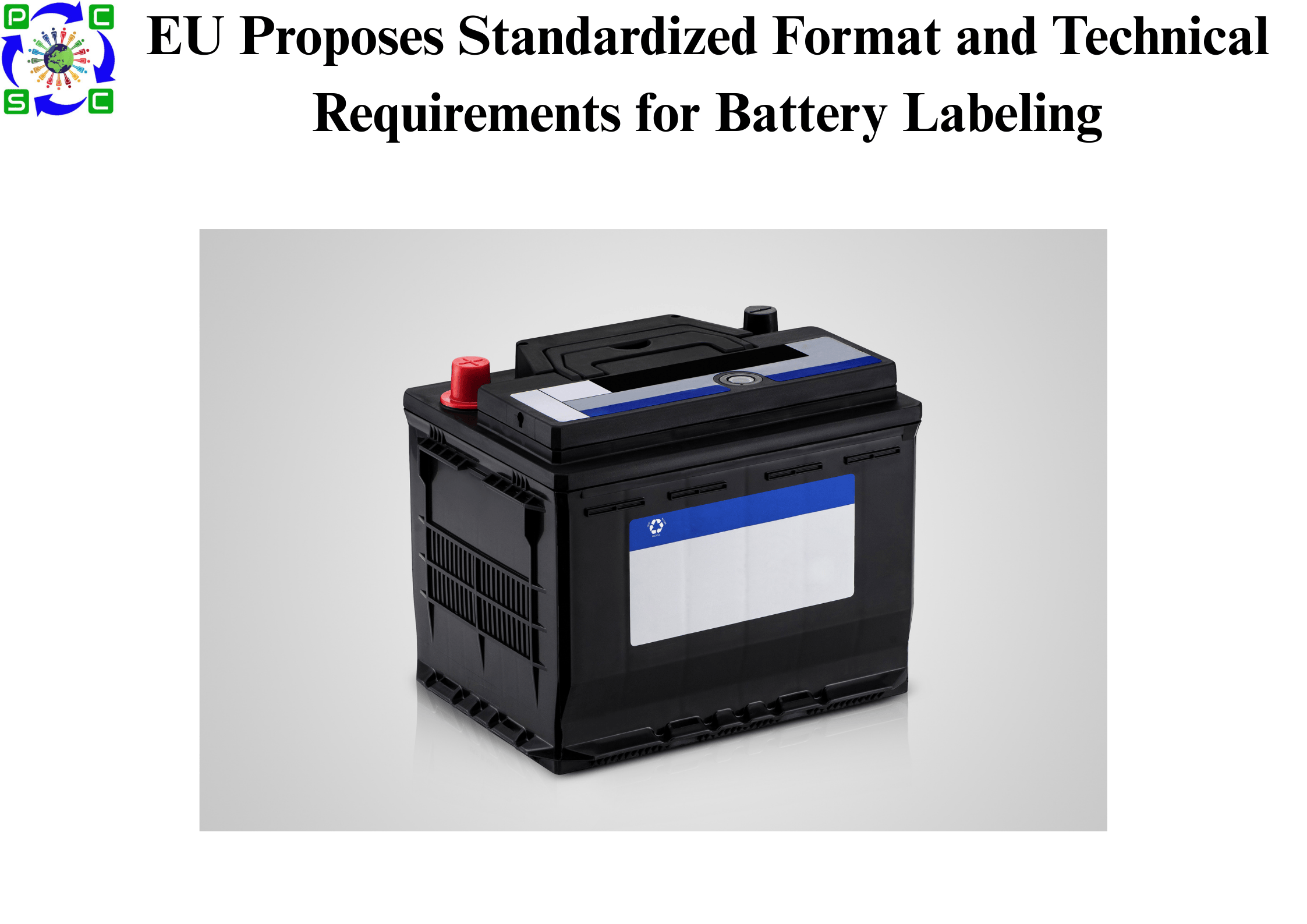
On December 15, 2025, the European Commission issued a draft regulation to standardize the format and technical specifications of battery labels, supporting the implementation of the EU Battery and Waste Battery Regulation (EU) 2023/1542. The draft outlines the following key elements:
1. Harmonised battery labelling requirements All batteries must display the information specified in Annexes I, II, and III, based on their category (e.g., non-rechargeable, rechargeable, industrial). Labels must follow the prescribed formats. Where space is limited or readability and safety could be compromised, information may be split across multiple labels. If the battery surface cannot accommodate the required details, information may be placed on the packaging or accompanying documents, supported by a QR code for digital access. If packaging space is also insufficient, information must be provided through accompanying documentation and QR codes.
Special provisions apply to certain battery types:
· Button cells: Information must appear on packaging or accompanying documents, with QR code access.
· Embedded batteries (e.g., medical devices): Information is provided via a QR code placed on the product, battery, or instruction manual.
When space is constrained, information must follow the priority order (I to XI) listed in the annexes. If indicating the manufacturing date results in disproportionate costs, it may be embedded elsewhere (such as within a serial number), provided the label clearly states where it can be found.
2. Label design, size, and placement Labels must comply with the formats defined in Part B of Annexes I, II, and III, ensuring clarity and high contrast. They must cover at least 5% of the maximum printable surface of the battery or packaging. Icons may not exceed 2.5 cm × 2.5 cm, and font sizes must not exceed 25 pt. Approved fonts include Noto Sans or other open-source typefaces compatible with EU official languages. Labels should be placed on the most visible side of the battery, remain legible throughout its lifecycle, and avoid conflicts with other mandatory markings such as CE symbols. For battery packs made up of multiple modules, the label must be affixed to the external casing, with optional QR codes on individual modules.
3. Non-rechargeable battery marking Non-rechargeable batteries must display the “Do Not Charge” symbol in accordance with IEC 60086-4, with a minimum size of 5 mm × 5 mm. If space is insufficient, the symbol may appear on packaging or accompanying documents and be made available digitally via QR code.
4. Marking of restricted and hazardous substances If batteries contain restricted substances (below regulatory thresholds) other than mercury, lead, or cadmium, their chemical names must be stated. The same applies to substances classified as hazardous.
Chemical naming must comply with Article 18 of the CLP Regulation (EC) 1272/2008 and the formatting rules set out in the annexes.
5. Priority order for mandatory information When space limitations prevent full labelling, the following order of priority applies:
1. QR code (digital information access)
2. Separate recycling symbol (crossed-out wheeled bin)
3. Heavy metal symbols (mercury, cadmium, lead)
4. Non-rechargeable battery symbol
5. General battery information (e.g., capacity, chemistry)
6. Language and accessibility requirements Label information must be provided in a language easily understood by consumers in the relevant member state. Where multiple languages are required, one language may appear on the physical label, with additional languages provided digitally via QR code—unless national legislation mandates multilingual labelling. All consumer-facing information must comply with the EU Accessibility Directive (EU) 2019/882 to ensure accessibility for persons with disabilities.
7. Carbon footprint labelling Batteries subject to carbon footprint performance classes—such as EV batteries, industrial batteries above 2 kWh, and LMT batteries—must use the uniform carbon footprint label defined in Annex V. This label must be affixed to the battery and uploaded to the public section of the battery passport in line with Annex XIII of Regulation (EU) 2023/1542.
The draft is open for public consultation until January 12, 2026. Adoption by the European Commission is anticipated in Q2 2026, followed by publication in the Official Journal of the European Union.