



 Authorised IMDS & CDX Training & Consulting partner for


 More stringent concentration limits and particular exclusions for UV-328 and PFOA, its salts, and related chemicals have been included to the European Commission’s revised POPs Regulation.
Significant changes to Annex I of Regulation (EU) 2019/1021 on persistent organic pollutants (POPs) were recently announced by the European Commission. These changes especially address the chemicals UV-328 and perfluorooctanoic acid (PFOA), its salts, and compounds linked to PFOA. The Commission Delegated Regulation (EU) 2025/843 and Commission Delegated Regulation (EU) 2025/1399 contain the amendments that are intended to further limit the use and presence of certain dangerous substances in the European Union.
Amendments Concerning UV-328
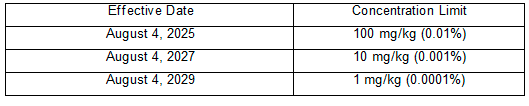
In particular, UV-328 (2-(2H-benzotriazol-2-yl)-4,6-di-tert-pentylphenol, CAS No. 25973-55-1), a material mainly employed as a UV absorber, is covered by Commission Delegated Regulation (EU) 2025/843. When UV-328 is found in substances, mixes, or articles as an unintended trace contamination (UTC), the regulation establishes new, increasingly stringent concentration limitations. To guarantee a steady phase-out and give industry time to adjust, these limitations are set to gradually diminish.
Revised UTC Limits for UV-328:
The rule also specifies particular exceptions for the use and placement on the market of products containing UV-328, acknowledging the intricacy of some industrial uses and the requirement for a transition time. Unless otherwise noted, these exemptions typically last until August 4, 2030, and they apply to several crucial industries:
· in land-based motor vehicles
· in industrial coating for land-based motor vehicles, engineering machines, rail transportation vehicles, and in heavy-duty coatings for large steel structures
· in mechanical separators in blood collection tubes
· in triacetyl cellulose film in polarisers
· in photographic paper
· in civilian and military aircrafts.
The exemption lasts until the end of their service life or December 31, 2043, whichever comes first, for spare parts in land-based motor vehicles, stationary industrial machinery for forestry, construction,
and agriculture, and liquid crystal displays in instruments for analysis, measurements, control, monitoring, testing, production, and inspection (apart from medical applications), where UV-328 was first used. Until the end of their service life, spare parts for liquid crystal displays in medical devices (Regulation (EU) 2017/745 and (EU) 2017/746) and other analytical instruments are exempt. Up to December 31, 2030, spare parts for both military and commercial aircraft are exempt.
Amendments Concerning PFOA, its Salts, and Related Compounds
Several significant modifications to the regulation of perfluorooctanoic acid (PFOA), its salts, and chemicals linked to PFOA are brought about by Commission Delegated Regulation (EU) 2025/1399. New specified UTC limits for PFOA in firefighting foams are one important modification.
For fire-fighting foam for liquid fuel vapour suppression and liquid fuel fire (Class B fires) already installed in systems:
· Concentrations of PFOA or any of its salts must be equal to or below 1 mg/kg (0.0001 % by weight).
· Concentrations of any individual PFOA-related compound or combination of PFOA-related compounds must be equal to or below 10 mg/kg (0.001 % by weight).
· These limit values will apply until August 3, 2028.
For fluorine-free firefighting foam originating from firefighting equipment that has undergone cleaning in accordance with the best available techniques:
· The sum of the concentration of PFOA, its salts, and PFOA-related compounds must be equal to or below 10 mg/kg (0.001 % by weight).
Additionally, the transitional period for some applications, such testing and training, is extended from July 4, 2025, to December 3, 2025, for firefighting foam already installed in the system for liquid fuel fire (Class B fires) and liquid fuel vapour suppression.
Stay ahead in sustainability compliance with Global PCCS —where expert insights meet the latest regulations. Unlock a future where compliance fuels sustainability, helping your business thrive in a greener, well-regulated world. For more information, contact us at info@globalpccs.com
