



 Authorised IMDS & CDX Training & Consulting partner for


 The new Law on Chemicals incorporates the regulation of dangerous chemicals in products and goods and simplifies the management of chemical activities.
Law No. 69/2025/QH15 on Chemicals was just passed by the National Assembly of Vietnam and will go into effect on January 1, 2026. This new law fundamentally restructures the nation’s chemical management system, enacting important modifications to support industry development that is synchronised, sustainable, and safe.
Controlled Substances and Management Practices
· A more sophisticated and efficient method of handling different types of chemicals and chemical processes is introduced in Chapter III (Articles 9 to 19) of the new Chemical Law.
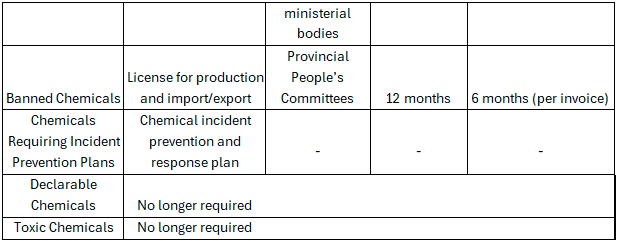
· The revised law substitutes “chemicals requiring special control” for the “restricted chemicals” found in the prior version.
· This designation is applicable to chemicals that pose possible risks to national defence, security, social safety, human health, facilities, property, or the environment, as well as hazardous substances and mixtures that the government has identified, particularly those covered by international treaties that Vietnam has signed.
· Notably, “toxic substances” with a broad definition has taken the role of the term “toxic chemicals,” which is defined precisely by the GHS criteria.
· The “toxic chemicals” purchase and sale regulation has been incorporated into the “chemicals requiring special control” group regulation.
· Furthermore, the “chemicals subject to declaration” list is left out. All imported chemicals, except for those that are already approved as “chemicals requiring special control,” “restricted chemicals,” and other government-granted exemptions, will instead need to be declared upon customs clearance.
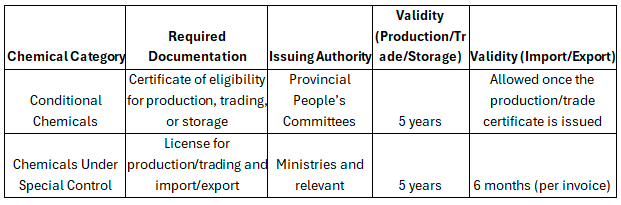
· All things considered, the law uses a tiered management system for controlled chemicals: the least stringent requirements apply to conditional chemicals, which are followed by compounds that need special supervision and, finally, substances that are prohibited.
Below is a summary of the new Law on Chemicals’ regulatory status for chemicals:
The New Substance
· “Chemicals that are not named under national lists of chemicals and foreign lists of chemicals recognised by Vietnamese authorities” are the definitions of novel chemicals under the current law, which are identical to those in the previous version.
· The official Chemical Inventory (NCI), Vietnam’s official chemical list, has not yet been made public. The addition of recognised foreign lists (now from the USA, EU, and Japan) on the national database greatly increases the total to 175,481 items, even if Vietnam’s NCI is still in draft shape and has about 41,881 entries.
· Since certain compounds might be regarded as existing chemicals in Vietnam and won’t need fresh registration, this is good news for companies that have already registered their chemicals in these nations.
· Both written paperwork and risk assessment information from legally recognised organisations will be needed for new compounds to be registered.
· These new substances will be handled as “chemicals requiring special control” after they are registered.
Products and Goods Containing Hazardous Chemicals
· Regulations pertaining to dangerous chemicals found in goods and products will be strengthened by the new law. Vietnam has issued or plans to publish several QCVNs (National Technical Regulations) for items thus far, such as:
· QCVN on hazardous substances in electrical and electronic products: Circular No. 30/2011/TT-BCT was to be replaced by a Draft National Technical Regulation QCVN….:2022/BCT, which is anticipated to go into force on January 1, 2026.
· The Ministry of Health has published QCVNs (such as QCVN 12-1:2011/BYT, QCVN 12-2:2011/BYT, etc.) that specify the safety and hygienic standards for items that come into direct contact with food.
· Ministries will publish a list of dangerous compounds found in goods and products in addition to the current technical restrictions.
· Before items and goods are put on the market, manufacturers and importers are required to disclose any hazardous chemical content on their websites, in the national chemical database, or at the points of sale.
Provisions for Transition:
The Law becomes operative on January 1, 2026. However, as of July 1, 2026, the requirements for a certificate of eligibility for chemical storage services for compounds that need specific control will be in effect.
Additional provisions for transition include:
· Chemical production or trade licenses granted prior to January 1, 2026, will remain valid until their expiration.
· Eligibility certificates for trade or production issued prior to January 1, 2026, will remain valid until December 31, 2027.
· Plans for preventing chemical incidents that were authorised prior to January 1, 2026, will continue to be in place.
· The requirements under the new law must be met by December 31, 2026, if a new chemical is identified as “conditional chemicals” or “chemicals requiring special control,” which are not specified under the original Law on Chemicals (No.06/2007/QH12).
Stay ahead in sustainability compliance with Global PCCS —where expert insights meet the latest regulations. Unlock a future where compliance fuels sustainability, helping your business thrive in a greener, well-regulated world. For more information, contact us at info@globalpccs.com
