



 Authorised IMDS & CDX Training & Consulting partner for


 On September 25, 2025, the Canadian government published the “Consultation Document on Phase 1 of the Risk Management of Per- and Polyfluoroalkyl Substances (PFAS)”, proposing to ban the manufacture, import, sale, and use of currently unregulated PFAS in firefighting foams. Transition periods will vary depending on specific use scenarios.
Background:
· On March 8, 2025, Environment and Climate Change Canada (ECCC) and Health Canada (HC) released the PFAS Status Report and a Proposed Order to add PFAS (excluding fluoropolymers) to Schedule 1, Part 2 of CEPA.
· A three-phase risk management approach was also outlined:
o Phase 1: Ban PFAS in firefighting foams.
o Phase 2: Ban PFAS not essential for health, safety, or environmental protection, particularly in consumer products with available alternatives.
o Phase 3: Assess and potentially ban remaining PFAS uses that require further evaluation.
Key Content:
1. Classification of PFAS-Containing Firefighting Foams
a. PFOS-based AFFF: Traditional foams containing perfluorooctane sulfonic acid (PFOS).
b. C8 AFFF: Traditional fluorotelomer foams with a high proportion of long-chain PFAS (≥C7).
c. C6 AFFF: Modern fluorotelomer foams with short-chain PFAS (≤C6) and no significant long-chain PFAS impurities.
2. Proposed Regulatory Measures
a. Ban the manufacture, use, sale, and import of firefighting foams containing unregulated PFAS (e.g., C6 AFFF).
b. Prohibit use in training or testing, except in closed systems.
c. Sales ban applies broadly, with limited exceptions for mutual aid rescue operations.
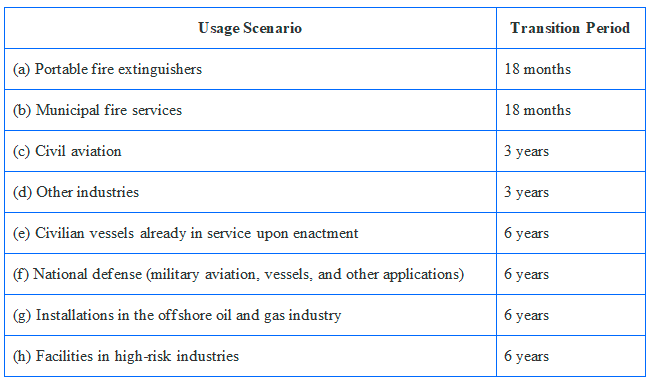
3. Proposed Transition Periods
The Canadian government has outlined transition periods of 6 months to 6 years, depending on the specific usage scenario.
4. Disclosure Requirements
Proposed Requirement: Manufacturers and sellers of AFFF (aqueous film-forming foam) must provide written disclosure to purchasers within 6 months after the regulation takes effect, including:
· Specific types and concentrations of intentionally added PFAS in the product
· The category of AFFF to which the product belongs
5. Labeling Requirements
Proposed Requirement: Labels must be affixed to AFFF in firefighting systems, stockpiled foam, and PFAS-containing wastewater/firewater, including:
a) A warning label if total PFAS concentration ≥ 1 mg/L b) Identification of AFFF category (if applicable)
Labeling must be completed within 18 months after the regulation takes effect.
In addition, non-fluorinated firefighting foams generated from decontaminated fire suppression systems with residual PFAS contamination ≤ 50 mg/L must also carry a residual contamination warning.
6. Management and Reporting Requirements
Proposed Requirement: User units must develop an on-site management plan that includes:
· Records of usage and discharge volumes
· Waste collection and disposal methods
· Employee training and emergency response plans
· Transition strategies to alternative solutions
Annual reporting and on-site inspections may also be required.
7. Information Collection
The government is requesting input from the public, businesses, firefighting agencies, and other stakeholders, specifically regarding:
· Manufacture, import, use, and/or sale of PFAS-containing firefighting foams (excluding currently unregulated fluoropolymers, e.g., C6 AFFF) and potential alternatives.
· Practices related to the full or partial reuse of fire suppression systems containing PFAS, especially where systems have been decontaminated but may still cause cross-contamination in alternative foams.
Submission Details: · Comments may be sent via email to AFFF@ec.gc.ca
· Deadline for submissions: November 25, 2025
Next Steps:
· Publication of a proposed instrument in the Canada Gazette by spring 2027, followed by a 60-day public consultation.
· A final instrument to add PFAS (excluding fluoropolymers) to Part 2 of Schedule 1 of CEPA will be issued within 18 months after the proposed instrument is published.
· The instrument is therefore not expected to take effect before spring 2029.
Stay ahead in sustainability compliance with Global PCCS —where expert insights meet the latest regulations. Unlock a future where compliance fuels sustainability, helping your business thrive in a greener, well-regulated world. For more information, contact us at info@globalpccs.com
