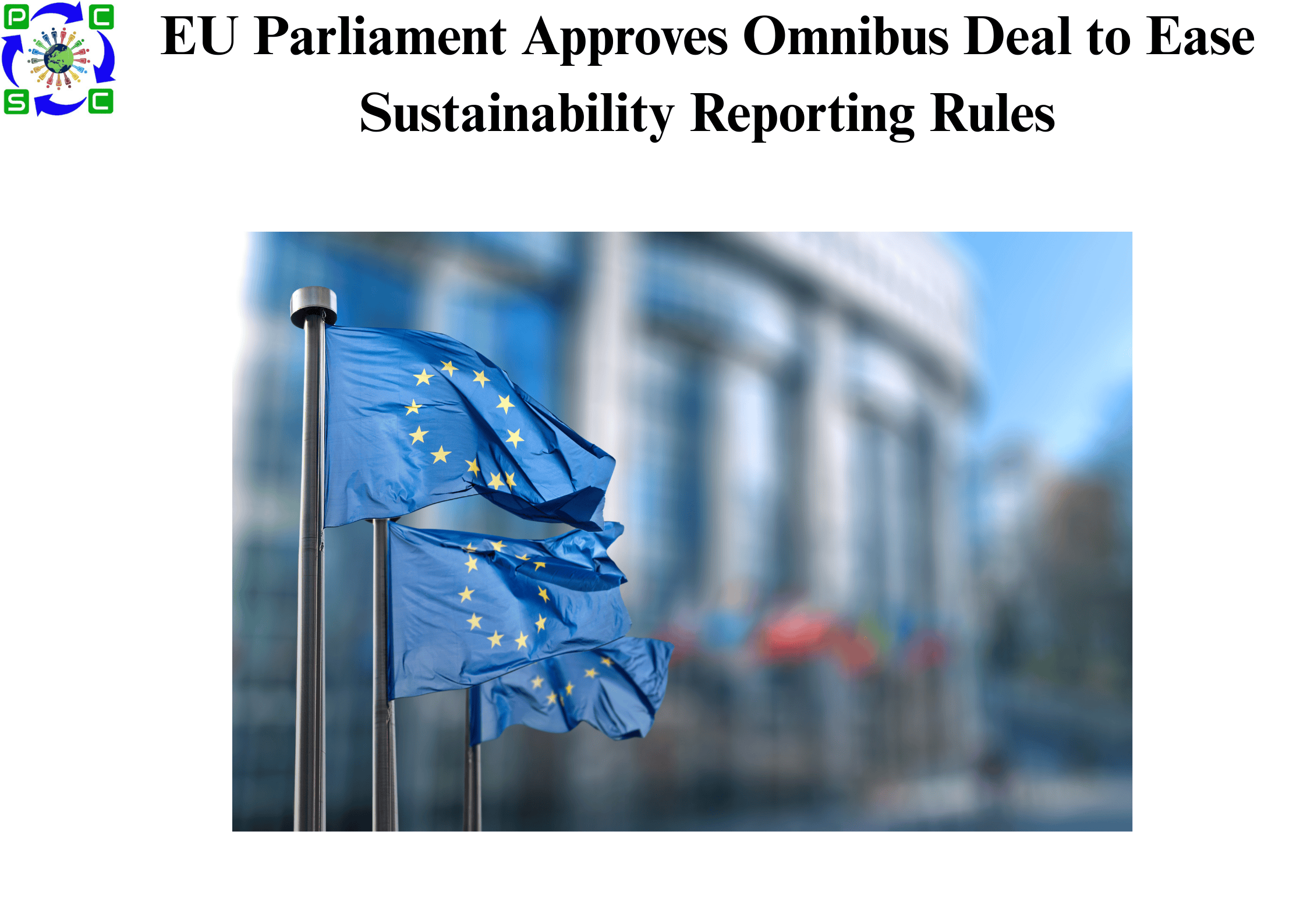
Members of the European Parliament have approved a provisional agreement reached last week with EU member states to substantially reduce corporate sustainability reporting and due diligence obligations. The agreement was adopted with 428 votes in favor, 218 against, and 17 abstentions.
This vote represents one of the final steps toward the adoption of the Omnibus I package, unveiled by the European Commission in February to simplify sustainability-related compliance requirements. The package targets key frameworks such as the Corporate Sustainability Reporting Directive (CSRD) and the Corporate Sustainability Due Diligence Directive (CSDDD). Final entry into force remains subject to approval by EU member states in the Council.
Under the Commission’s original proposal, the scope of the CSRD would have been reduced by around 80%, by increasing the employee threshold from 250 to 1,000 employees, while maintaining the same threshold for the CSDDD. The proposal also narrowed due diligence obligations to direct business partners, unless credible information indicated risks further along the value chain, and introduced limits on data requests to smaller supply chain companies.
However, both the European Parliament and the Council went beyond the Commission’s proposal, resulting in even deeper cuts to the scope of both directives.
While the agreement retains the 1,000-employee threshold for the CSRD, it introduces an additional €450 million annual revenue threshold, effectively excluding companies below this level and removing an estimated 90% of firms from the reporting requirements.
The changes to the CSDDD are more far-reaching, with the applicability threshold increased to 5,000 employees and €1.5 billion in annual turnover, significantly narrowing the number of companies subject to due diligence obligations.
The agreement also includes review of clauses for both the CSRD and CSDDD, allowing for the potential future expansion of their scope.
Beyond scope reductions, the agreement introduces further amendments, including the removal of the CSDDD requirement for companies to develop climate transition plans, the elimination of an EU-wide civil liability regime, and a reduction in potential penalties to a cap of 3% of global turnover.
Consistent with the Commission’s proposal, the agreement also restricts the information that in-scope companies may request from smaller value chain partners. Companies with fewer than 1,000 employees may refuse to provide information beyond the Voluntary Sustainability Reporting Standard for SMEs (VSME), and companies subject to the CSDDD are encouraged to rely primarily on reasonably available information rather than routinely requesting extensive data from smaller suppliers.