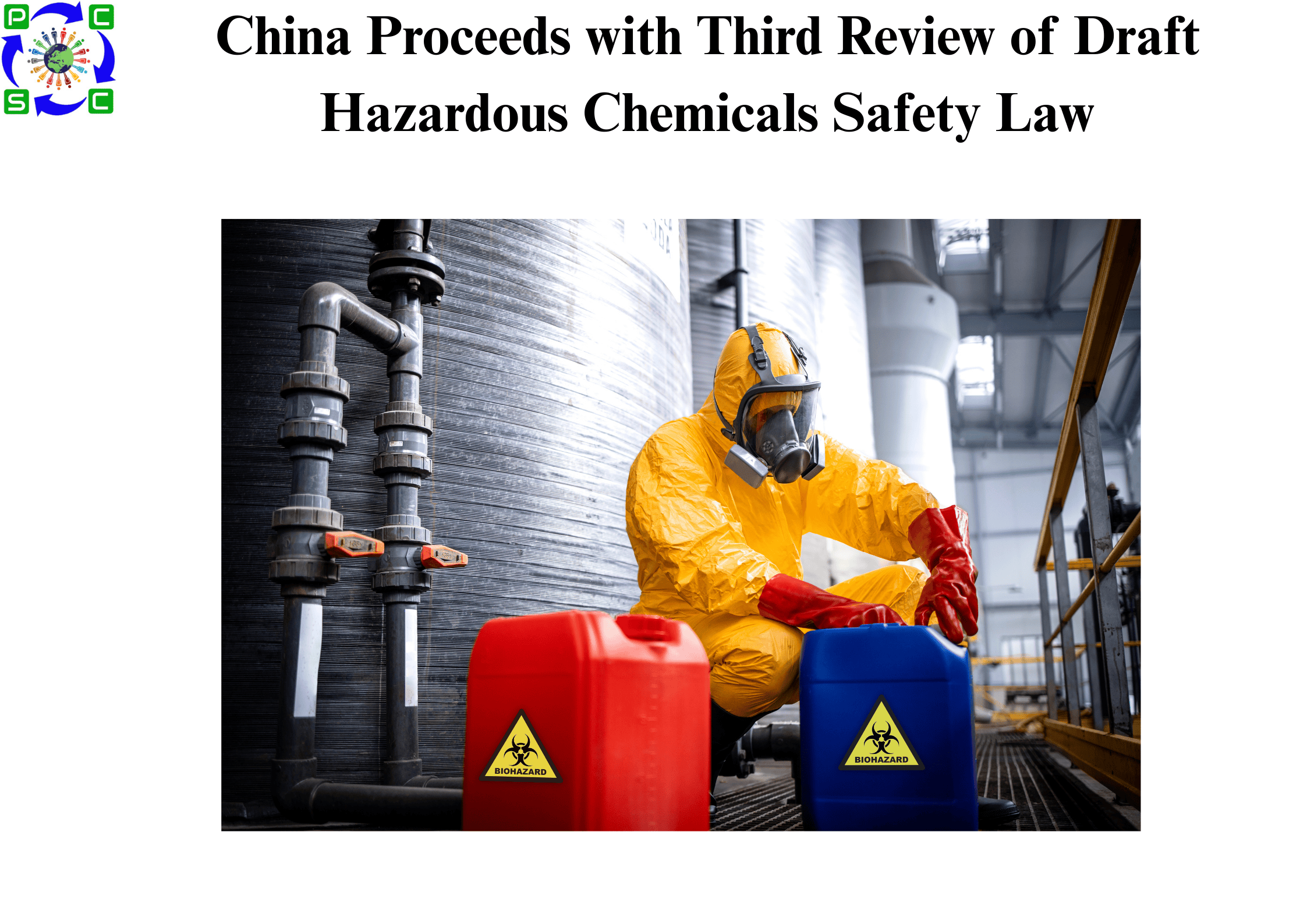
The draft Hazardous Chemicals Safety Law was formally presented for a third review on December 22, 2025, during the 19th Session of the Standing Committee of the 14th National People's Congress. After that, the document will be made available to the public for review in order to gather general feedback. The document was previously reviewed twice: once in December 2024 at the Standing Committee's 13th Session and again in September 2025 during the 17th Session.
Context
With a huge industrial scale encompassing many industries, China is a significant global producer, user, importer, exporter, and consumer of hazardous chemicals. Nonetheless, the state of manufacturing safety is still dire. Specialized legislation is required to improve safety governance skills since the current legal framework is unable to fulfill the safety management demands of the entire supply chain and numerous stages. Regulations on a number of aspects of hazardous chemicals in China are outlined in the draft, including registration and identification, planning and siting, production and storage safety, use safety, operational safety, transport safety, waste disposal safety, emergency rescue for accidents, and legal liabilities. It seeks to create a safety supervision system that is relevant to the manufacturing, storage, use, operation, and management of hazardous chemicals throughout their whole lifecycle.
New Clauses in the Third Draft for Review Strengthen Employees' Regular Safety Training
The third draft includes measures requiring hazardous chemical production companies to create and strengthen safety training management systems, schedule frequent training sessions, and increase employees' safety awareness and abilities in addition to mandating pre-job training and evaluation.
Use Dynamic Monitoring in Road Transportation
Road transport companies that transport hazardous chemicals must monitor and control the operating state of vehicles and drivers in real-time. They must also swiftly address any prohibited driving behaviors, such as speeding, driving when fatigued, and straying from specified routes.
Protect the Public's Right to Know
Every three years, businesses that manufacture or store hazardous chemicals must engage an organization to evaluate their production safety conditions and generate a safety assessment report. Plans for resolving issues found in the production safety conditions and definitive opinions upon rectification must be included in the report, which must be made public.
Control Your Own Use
Hazardous chemicals must not be used, stored, or disposed of unlawfully, and those who utilize them should be aware of their dangerous characteristics, proper usage techniques, and safety precautions.
Boost Responsibility
The draft restricts the professional practice of principal responsible individuals in accordance with the legislation, increases the amount of fines for violations, and imposes fines on directly responsible managers and other directly liable workers for certain serious infractions.
Essential Elements of the Draft Law
Tight Safety Control at Every Stage and Throughout the Chain
In order to enhance regulatory measures, it proposes precise rules or coherent provisions for the safety management of each stage, including registration, manufacture, storage, use, operation, transportation, and disposal of hazardous chemicals.
Boost Hazardous Chemical Entities' Primary Responsibility
The implementation of a whole-staff production safety responsibility system, the improvement of processes for detecting and addressing hidden hazards, the installation of safety facilities and equipment, and the improvement of staff safety awareness and proficiency are all mandatory for hazardous chemical entities.
Make Government Supervision Responsibilities Clear
In order to improve regulatory coordination and cooperative law enforcement, it makes clear how various departments, including emergency management, public security, market regulation, ecology and environment, and transportation, are responsible for supervising and managing hazardous chemical safety.
Organize Siting and Planning
In addition to strengthening the certification, re-evaluation, and safety management of chemical industrial parks and raising their levels of safety management, it necessitates coordinated planning and sensible siting for the production and storage of hazardous chemicals.
Boost Team Building and Emergency Rescue Capabilities
It mandates that hazardous chemical entities and local people's governments at the county level and higher expand the development of emergency rescue capabilities, carry out emergency exercises, and enhance personnel's emergency response capabilities.
Encourage a Social Climate That Supports the Safety of Hazardous Chemicals
It mandates that information about hazardous chemical safety be promoted and disseminated, and it promotes reporting infractions and significant accident risks.